

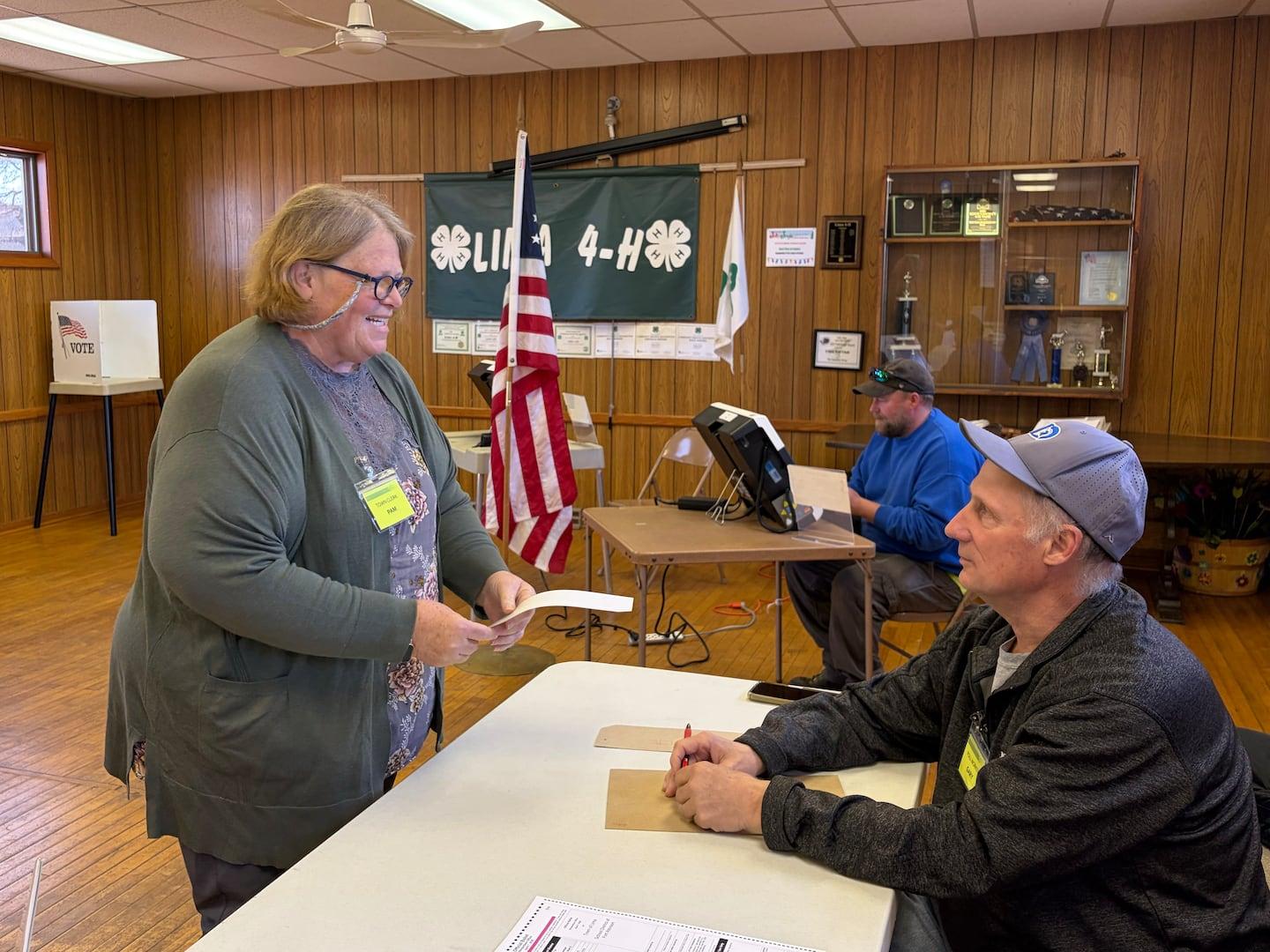


ROCK COUNTY, Wisc. — Town of Lima Clerk Pam Hookstead’s election operation is a well-oiled machine. She comes to the polls at 6 a.m., a pot of cowboy beef stew in hand to warm up for her poll workers, and takes a backseat as she lets the town’s longtime staffers settle into their rhythm.
Having run well over 100 elections, administering the Wisconsin Supreme Court race on April 7 in the 1,200-person town felt like second nature. Hookstead, now 65, has spent three decades in the role — a depth of experience many towns have lost since 2020.
Twenty miles south sits Clinton, where 59-year old Town Clerk Shannon Roehl-Wickingson was administering her first election on her own. It will take years for her muscle memory to rival Hookstead’s. But, she may get there faster than many of her peers in Wisconsin — or across the country. Rock County has a support and training system that most new clerks can only dream of.
That kind of hands-on help the county provides is increasingly rare. Nationwide, election official turnover has hit record highs since 2020, driven by harassment, political pressure, and exhaustion. And Wisconsin has been especially hard hit: Since elections are run at the municipal level, the state relies on around 1,850 individual municipal clerks to run its elections. Many new clerks land the job with little guidance and figure it out as they go.
As the job has grown more complex, more scrutinized, and more politicized, municipalities are left scrambling to replace experienced officials and train newcomers fast enough to keep up. Rock County — where five of 29 municipalities had first-time clerks running elections last week — is testing a more hands-on approach to that transition, pairing new clerks with experienced ones and building a network that helps them learn the job in real time.

But hiring is only half the battle. Keeping clerks can be even harder, in part because the job is both sprawling and slow to master. Beyond running elections, a single clerk may take meeting minutes, issue licenses, sell public land and even oversee cemeteries. All responsibilities, especially elections, are governed by a shifting patchwork of legal obligations that can take years to learn but often change quickly. Rock County is hoping to fix that.
“If I wouldn’t have had help, I might have thrown in the towel by now because it’s very daunting,” said Roehl-Wickingson. “For God’s sake, in today’s climate, with voting, you just don’t want to make mistakes. But there’s tremendous support. You just have to ask the questions.”
The approach is deliberate: County Clerk Lisa Tollefson ensures municipal clerks are trained beyond state requirements, and works to recruit long-serving or retiring clerks as mentors. During the busiest times of the year, her husband, Town of Harmony Deputy Clerk Tim Tollefson, makes the rounds to check in with new municipal clerks to make sure everything is moving smoothly.
Together, they push clerks to stay in close contact, with them and with each other — swapping advice on absentee voting, preparing for budget season, or gathering in person with a brandy Old Fashioned to celebrate a well-run election.
Part of Tollefson’s motivation for creating the county’s support network comes from experience. When the Democrat first became Harmony’s town clerk in 2010, she knew resources were available but “felt really shy about reaching out” for help. “I don’t want anyone to ever feel that way.”
Now, she goes to public tests for every new clerk, making sure they understand there’s no dumb questions and telling them that she has been in their shoes.
In Hookstead’s view, Lisa Tollefson is the coach, municipal clerks are the assistant coaches, and poll workers are the team players.
“None of us could survive without the other one,” she said. “We’re a team. We work very well together in this county.”

‘Clerk gene’ essential to long tenures
Making a longtime clerk out of a new recruit takes some luck and some science.
In some cases, it also starts off with a little bit of deceit.
Many clerks have similar origin stories in Wisconsin: They were persuaded to begin their jobs by a town board member who made the job sound easy. Just taking minutes, they’re told. Little mention of elections, budgets, licenses or managing municipal property. That was the pitch that drew both Tollefson and Hookstead into their first clerk jobs.
Once on the job, they quickly realize how much more it entails. Some hunker down. Others leave.
What separates the two, Lisa Tollefson said, is the “clerk gene.” She described it as a mix of curiosity, a lack of timidity, and a desire to help the public. And while some — herself included — stumble into the role of clerk and step up to the job, Tollefson said transparency about the job is the best way to recruit and retain staff. “Being open about all the duties,” she said, “is huge.”
Roehl-Wickingson, whose previous job included helping union workers sign up for benefits, said the desire to help others has carried over for her. In both elections and unions, those who are indifferent are “definitely in the wrong place.”
Right now, Lisa Tollefson said, every chief election official in Rock County has what it takes to be a clerk. That’s a blessing for her office, which saw a lot of clerk turnover after the highly contentious 2020 election, when a wave of retirements rocked the workforce. Just eight of 29 Rock County municipalities still have the same clerks as they did six years ago.
“There were some older clerks at that time,” she said, “and they’re like, ‘I’m not doing another. I’m done.’”

To keep new clerks from burning out, Lisa Tollefson tries to reinforce that instinct to be a supportive clerk with training and support.
She has encouraged her clerks to become trainers themselves, including to train poll workers to be chief inspectors and to use the state’s electronic pollbook system — something most poll workers aren’t usually trained to do.
The need for such advanced planning became clear in 2020, when nearly every worker at one Rock County polling location was exposed to COVID-19 during a public test and could no longer serve on Election Day. Two poll workers didn’t come to the public test, though, and because they were trained to be chief inspectors, the location was still able to open and proceed normally. That year, Tollefson also trained about 50 county employees as chief inspectors as an additional cushion against emergencies.
The benefits of this preparation and community-building also show up in smaller moments. At a recent public test of voting equipment, Tollefson said she watched experienced poll workers reassure a new clerk that everything would be OK. “There’s a lot of strength in the poll workers,” she said.
It’s an example set by Tollefson herself. She is a constant presence for clerks, Hookstead said. She offers advice and checks in, reminding clerks that she’ll be up at 5 a.m. and ready to provide any support she can offer on Election Day.
“She’s just willing to make our lives so much easier,” said Hookstead. “And it is through training — her trainings are fun.”
Rock County clerks also seem to have found another reliable strategy for finding and retaining election workers: recruiting family members.
After Tollefson left her first job as the Harmony town clerk, she recruited her husband to replace her after nobody else applied. He later became the town’s deputy clerk. Hookstead’s mom, daughter, and husband have all served as poll workers in Lima. In the Town of Magnolia — in western Rock County — clerk-treasurer Graceann Toberman was preceded by her mother as treasurer. Together, they’ve spent more than 60 years in the role.
Roehl-Wickingson was also recruited by family. When the Town of Clinton needed a new clerk, she got a call from her daughter, who works in the county clerk’s office, suggesting it would be a good part-time job in retirement. (Unlike Lisa Tollefson and Hookstead, Roehl-Wickingson said she received an accurate summary of what the job entailed.)
“You get the bug,” Lisa Tollefson said. “It happens all the time.”
Longtime clerk says county helps her understand changing rules
Hookstead has had the bug for 30 years. She has silvering blonde hair and, on Election Day, wore a green cardigan and a nametag identifying her as clerk — not that anybody is unfamiliar with her. She said she’s not quite ready to retire as a clerk.
If anything, she’s prepared to spend even more time on the job. Having just retired from her full-time position as secretary at a school in Whitewater, she’s decided to redesign the town’s website and re-organize its paperwork system.
Still, she knows she won’t do it forever. If somebody comes along to replace her — something Hookstead acknowledged wasn’t terribly likely — she said she’s ready to step aside.


Hookstead lives and does most of her work from home on a 180-acre beef farm in town.
The 1,300-person town is sparsely populated, with no bars, no restaurants, and no grocery stores — just dairy and cattle farms, a Presbyterian church, and a small cluster of homes near the town center. On Election Day, its town hall had pop-up voting booths next to its wood-paneled walls and a check-in booth by the front entrance, a setup that Hookstead has meticulously spaced out to provide the best flow for voters, some of whom are in wheelchairs.
For early in-person absentee voting, residents don’t go to a government office. They go to Hookstead’s house.
Voters go to her kitchen and take a seat at what she calls her voting table. Given its placement, with several seats surrounding it and a sack of onions on top, you’d be forgiven for calling it a kitchen table. Hookstead concedes it’s both.
Voters cast their ballots there, overlooking a cattle field and a swamp frequented by geese and sandhill cranes. If two voters come to her house at the same time, they sit on opposite corners of her kitchen table while Hookstead waits for them in the living room, near a mounted buck that her husband killed with a bow.
It’s a laid-back setting, Hookstead said — one where voters can both cast a ballot and talk about the price of corn.
When she started her job, things worked differently. There wasn’t much early absentee voting, and almost every voter cast their ballot on Election Day, hand marking them and dropping them into several wooden boxes at the town hall. Hookstead would unpack the ballots at the end of the night and hand-count for several hours.
Now, electronic tabulators and shorter ballots have sped things up. Even so, the job has grown more complicated — especially as election rules have shifted in recent years. Hookstead said she’s been frustrated by rapidly changing election rules since 2020, particularly when they don’t seem to follow clear logic. She pointed to one rule blocking voters from returning their elderly parents’ ballots, with only limited exceptions.
That’s where the county support system comes in.
Tollefson, the county clerk, notifies Hookstead and other clerks of new rules and guidelines — sometimes before the Wisconsin Elections Commission does — and always makes herself available for questions.
“I have told Lisa that when she leaves, I’ll be going,” Hookstead said.

New Clinton clerk runs successful election after weeks of nerves
In the Clinton Town Hall, just off County Road X, Roehl-Wickingson last week was running her first election as town clerk. She spent the day answering questions from poll workers, working through new problems, and greeting older residents curious about the new person running their elections.
Some had been skeptical, particularly because she lives 20 miles north in Harmony. A law passed last year allows municipalities to appoint clerks who live outside of town borders.
“I’ve been nervous all day,” she said, as she sat in the clerk’s office on Election Day with paperwork instructing her what to do at every step. She added that each time her chief inspector comes around to ask her a question, “I think, please let it be easy.”
Roehl-Wickingson was a longtime General Motors employee, working at the Janesville plant as an assembly worker until its mass-layoffs in late 2008. She then worked as a union representative at a GM plant in Kansas City, where part of her job was spent registering union workers to vote and getting out the vote. She retired in 2024, wanting to get back home to her family in Rock County.
But retiring doesn’t mean she’s “ready to sit still in the rocking chair,” Roehl-Wickingson said from her office, where she sat beneath a street sign reading “Clerk Way.” She shuffled through stacks of paper, checking lists, double-checking them, pausing only to answer a question before returning to the lists.
When her daughter told her about the clerk opening, she felt she was the right person to take it on. Roehl-Wickingson said her position as a union rep prepared her for the contentious election landscape.
“I won’t say I’m thrilled to death about it, but I knew the atmosphere,” she said. “I don’t have anything to hide.”
Even so, the lead-up to Election Day was consuming. She said she barely slept the night before, instead rereading the election manual again and again, afraid she might miss something.
“My husband was like, ‘You’re gonna get sick,’ because I’ve been nervous the last couple of weeks and running ragged, making sure I had everything,” she said.
By early afternoon on Election Day, Tim Tollefson had turned up to meet with Roehl-Wickingson. He was making his way around the county to check on new clerks, a task he took on after his wife encouraged him to help mentor the wave of new clerks.
Much of the job, he said, is procedural, not entirely different from managing inventory at his former job as a manager at the outdoor recreation retailer Gander Mountain. Tollefson said some bits came easy for him, and the rest came with time. Two years, he said, is around how long it can take to start feeling like you have a grip on the role.
Until then, it can be overwhelming.
Both Tollefsons have been essential to her success, Roehl-Wickingson said. Without the support system, she said she would have felt lost doing things like compiling the town budget.
“You definitely need guidance,” she said. “You just don’t know what you don’t know,” she said.
That guidance extends beyond any one person. Over time, Roehl-Wickingson said, the job has started to make more sense — in part because of formal training, but just as much because of the network of clerks across the county.
“If [Lisa] didn’t pull us together, I’m not sure we would have that on our own,” she said.
By Election Day, Roehl-Wickingson had done everything she could to prepare. Too nervous to set up the polling place the day before, she went in on the Saturday before Election Day, spending hours making sure every table, sign, and voting booth was exactly where it needed to be.
As the day wound down, she glanced at the analog clock on the wall: just before 8 p.m.
The room had emptied. No last-minute voters came through the door.
When the clock struck the hour, her chief inspector closed the polls.
There was plenty left for Roehl-Wickingson to do. But first, she checked the numbers — ballots cast versus the number of voters checked in.
Both were 225.
“I’m so glad,” she said, thanking her chief inspector.
For all her nerves, the first outing of Roehl-Wickingson’s late-blooming career as an election official was a success.
“At times, it’s very consuming and daunting and overwhelming, but at the same token, today, I feel kind of a sense of excitement,” she said. “And it’s rewarding to know that you’ve been a part of it, and you put it together, and you’ve been that cog in the wheel.”
Alexander Shur is a reporter for Votebeat based in Wisconsin. Contact Alexander at [email protected].