






Aside from about 15 people who faithfully attend each Sunday morning service, Dodgeville’s Plymouth Congregational United Church of Christ used to sit empty most of the week.
No one filled the rows of wooden pews, gazed at the ornate stained glass windows or found community in the basement fellowship hall and kitchen.
All that empty space reflected a common set of challenges facing communities across America, particularly in rural areas: shrinking church membership, growing loneliness and isolation, and a lack of third spaces to gather.
But in summer 2023, the congregation joined local residents to open Merrimac and Main, a nonprofit community center aiming to directly address those issues.
How Merrimac and Main began
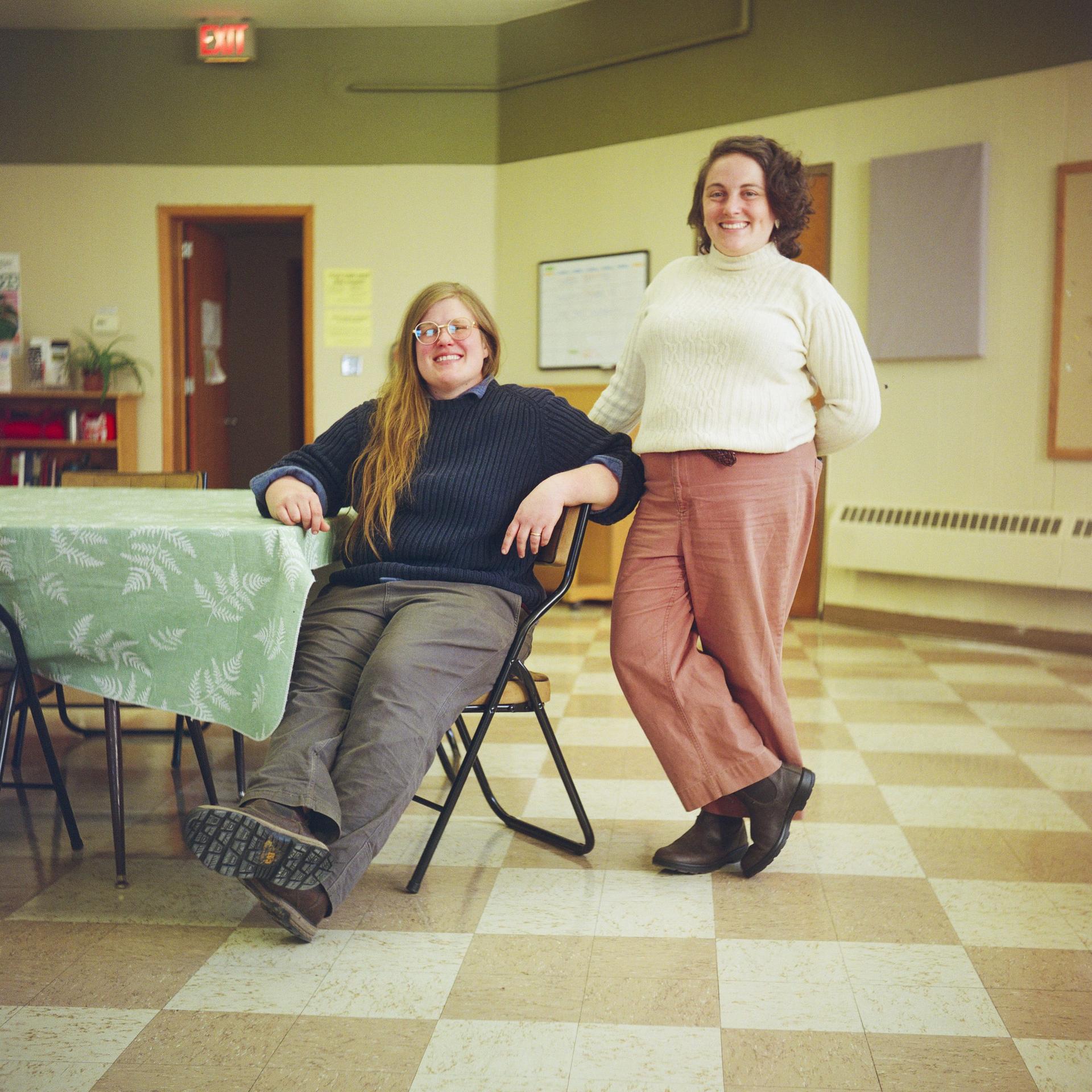
Rachel Peller and her wife Rebecca Krausert Sykalski had just moved into a housing cooperative east of Dodgeville and were looking for a place with internet access to work remotely. Peller is the director of Wisconsin Partners, a coalition of local and statewide groups collaborating across sectors, perspectives and communities.
She soon met Shirley Barnes, a longtime Dodgeville resident who chaired Plymouth Congregational’s board of trustees. Barnes had been racking her brain on what to do with her church’s history-rich but mostly vacant building, built in 1907, as its congregation aged and dwindled.
Within a month, Peller and Barnes joined about two dozen people in the church basement to brainstorm ways to use the space to serve the community.
“The timing was incredible,” Peller said.
One person suggested a makerspace to foster innovation. Another suggested a program for older adults. After a few more conversations that summer, the group decided on a catchall that enveloped many ideas for the space: a community center.
“There isn’t one in Dodgeville or anywhere nearby where people can come and just be, come and just exist,” Peller said.


By fall 2023, Merrimac and Main’s organizers held an open house to publicly seek feedback and share their vision — maybe a yoga room, a gallery space with art classes, a lecture hall and live music.
Aided by a grant in 2024, Merrimac and Main, an independent nonprofit that rents the church’s space, launched a four-lecture series and pop-up youth classes.
A space for just about everything
Merrimac and Main has since tried a bit of everything: sewing classes, cooking classes, a workshop on starting your own cottage food business.
“Since then, it’s just grown,” Peller said. “It’s been such an amazing project. So many people just show up and they have an idea and they make it happen.”
One of the center’s most successful recurring events, an international potluck, drew a crowd of 75 people who brought dishes representing about 20 countries.
In addition to one-off events open to anyone, the community center hosts a weekly senior program, a youth program and a recovery meeting, alongside a monthly Spanish conversation group.


Independent of the community center, Plymouth Congregational still holds service every Sunday, but the community center is more frequently in the building, Peller said.
“Basically our church was empty except on Sundays,” said Jan Helmich, a longtime congregation member and active participant in Merrimac and Main’s senior program. “There weren’t many places in town where people could rent space for a party or something, so we decided to see what we could do about it.”
Retirees find connection
While the church’s doors have always remained open to anyone on Sundays, Merrimac and Main’s programming has kept people coming through the building throughout the week.
On a Tuesday morning in January, Helmich sat at a table in the church’s basement rec room joined by nearly a dozen fellow retirees.
The day’s event featured a visit from the Iowa County Humane Society, whose volunteers brought in two kittens.


Tom DeVoss, who previously served as Iowa County sheriff, was on a walk around the neighborhood when he dropped in and found his wife, Kathy, conversing with the group. It’s good to see what’s going on in the community, to stop in and chitchat, Tom DeVoss said. “It’s kind of a come and go place.”
Kathy DeVoss, who has lived in Dodgeville for 21 years but still considers herself a newcomer, mentioned a Merrimac and Main event she attended last April where she learned to graft fruit trees. “It was so much fun,” she said.
Many of the attendees said they enjoyed the new opportunities for socialization.
“I’m not one to sit home,” said Lenore White, a first-time visitor who learned about Merrimac and Main at a local morning exercise class. “I want to get out and meet people.”
After school, a different kind of space

On a Tuesday afternoon in February, excited screams from children in an after-school program filled a room that on other days hosts the more reserved senior program.
Fifth graders Arlo Lockard and Henry Wepking shared a chair in a connecting room playing games on a smartphone. Arlo’s sister and another middle school girl sat at a table in the main room talking to one another.
Krausert Sykalski, Merrimac and Main’s building coordinator and Peller’s wife, rallied the day’s four children to make blankets for the humane society out of donated materials. Eight children usually attend each week, but half that day were instead participating in a school play, Krausert Sykalski said.
Sitting on the checkered floor, Arlo and Henry got to work. They took turns wielding a measuring tape and scissors, deftly cutting a blanket down to size. The friends began attending Merrimac and Main last September as soon as they were old enough for the program. They learned about it at Dodgeville Middle School from a cafeteria television that displays announcements.

On a typical day after school, the boys would play video games, participate in seasonal team sports, go fishing, ride their bikes or do chores. Now, they can walk a few blocks from the school to the church for the Tuesday programs.
“We’re not from here and we don’t have the social network that people who grew up here and went to school here, and either left or never did,” Halee Wepking, Henry’s mother, said while picking him up at the end of the program. “It’s really nice to have things like this for our kids.”
Originally from Arizona, Wepking and her husband, who is from southwest Wisconsin, moved to Ridgeway in 2016. There, they founded Meadowlark Organics, a farm and flour mill. Wepking said she learned about Merrimac and Main through her friendship with Peller and Sykalski.
Wepking said while there are traditional channels for socialization like sports that her kids participate in, “to have things that are community-oriented and creative and stuff is a real gift, especially for middle school aged kids.” The Wepkings noticed a gap in activities for middle schoolers in Dodgeville, making Merrimac and Main all the more meaningful.
“I’ve been trying to convince my friends to come, because it would be more fun, and I bet they would enjoy it,” Henry said.
‘It wasn’t just our church’
Helmich, who was working on another volunteer-based project at the nonprofit while the middle schoolers made blankets, reflected on conversations predating Merrimac and Main about selling the church. After some hesitation initially, Helmich said, the congregation acknowledged the community center as good for everybody.
“We got the community involved, it wasn’t just our church,” Helmich said.
Merrimac and Main has only grown since opening its doors. The same Tuesday Wisconsin Watch visited its youth program the nonprofit received a United Fund of Iowa County grant to support the free fruits and vegetables it offers during programs.
Peller and Krausert Sykalski continue to handle center operations, but they attribute much of Merrimac and Main’s success to engaging so many people to contribute in their own way.
How to get involved
Find Merrimac and Main’s calendar of events on its website, and learn more about how to volunteer to lead an activity, host a pop-up event, get the word out or donate.

Merrimac and Main organizers shared this advice for others looking to start community centers:
- Don’t just send an open invitation; personalize your message by directly asking people for what you need.
- Don’t get stuck trying to make everything perfect; treat early, low-risk events as opportunities to gather information and feedback.
- Engage people by helping bring their ideas to life.
- Lean on partnerships with other community organizations.
This story is part of Public Square, an occasional photography series highlighting how Wisconsin residents connect with their communities. To suggest someone in your community for us to feature, email Joe Timmerman at [email protected].